
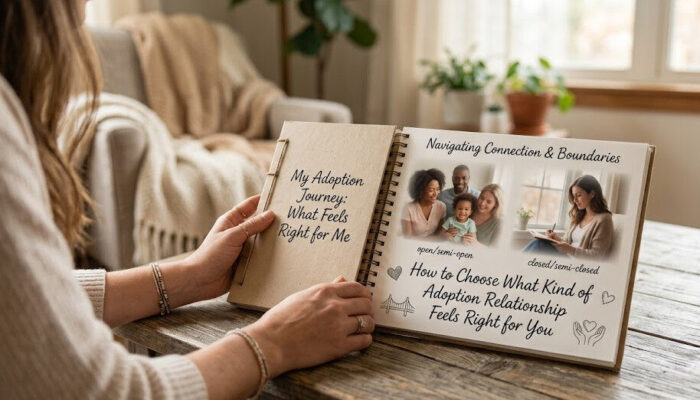
How to Choose What Kind of Adoption Relationship Feels Right for You
Your Adoption Relationship Can Be Built Around What Feels Right for You
Adoption is not one-size-fits-all
When you are making an adoption plan, one of the most important decisions you will face is what kind of relationship you want to have with the adoptive family and your baby after placement. There is no single right answer, and that is by design. Choosing the right adoption relationship is a deeply personal process, and it looks different for every birth mother.
Some women want to stay closely connected. Others need space and privacy to heal. Many fall somewhere in between, and these feelings will continue to ebb and flow throughout life. All of these are valid. The adoption relationship you choose should reflect your emotional needs, your comfort level, and the kind of future you are hoping to build, not what someone else did or what you think you are supposed to want.
Some birth mothers want ongoing contact, while others need more privacy
It helps to know that birth mothers approach this decision from many different places. Some women feel strongly that staying in their child’s life through visits, photos, or regular updates will help them find peace. Seeing that their child is loved and thriving gives them comfort and connection.
Other birth mothers find that having more distance supports their healing. They may not be ready for ongoing contact, or they may simply need privacy as they move forward. This is not a sign that they love their child any less. It is a recognition of what they need to take care of themselves.
Neither path is more loving than the other. The right adoption relationship is one that honors where you are, not where someone else expects you to be.
Your comfort level matters when thinking about future communication
As you think about what kind of contact feels right, pay attention to your instincts. If imagining a future where you receive annual photos feels comforting, that is worth noting. If the idea of regular visits feels like too much right now, that is worth noting too.
Your comfort level is not something to push through or ignore. It is information. The goal of choosing a contact plan is to create an arrangement that supports your wellbeing while keeping the door open for whatever relationship makes sense as time goes on. A plan that honors your boundaries is not a closed door; it is a foundation built on honesty.
You are allowed to ask questions before deciding what relationship feels best
You do not have to decide anything before you are ready, and you do not have to figure this out alone. Before you commit to a contact plan, you are allowed to ask as many questions as you need. What does ongoing contact actually look like in practice? What happens if one side of the relationship changes over time? What if I change my mind about how much communication I want?
These are not uncomfortable questions. They are important ones. A good adoption agency will welcome them and help you explore your options at a pace that feels right for you.
Understanding Your Adoption Relationship Options
When people ask “what kind of adoption is right for me,” they are usually asking about the level of contact they will have with the adoptive family after placement. There are three general options: open, semi-open, and closed, and each one offers a different kind of connection.
What open adoption can look like
Open adoption means there is direct, ongoing contact between the birth mother and the adoptive family. This can take many forms depending on what everyone agrees to. Some open adoption arrangements include in-person visits, holiday gatherings, birthday celebrations, or casual get-togethers throughout the year. Others focus on regular communication like phone calls, video chats, or messaging.
How open adoption works in practice is unique to each family. There is no fixed formula. What matters most is that everyone involved is clear about expectations and that the arrangement is built on mutual respect and what is best for the child.
Many birth mothers who choose open adoption find that staying connected helps them feel confident that their child is safe, loved, and growing up knowing where they came from.
What semi-open adoption can look like
Semi-open adoption sits in the middle ground. Birth mothers in semi-open arrangements typically receive updates — photos, letters, or milestone reports, but without direct contact or shared personal information. Communication often happens through the adoption agency, which acts as a neutral go-between.
This option works well for birth mothers who want to know how their child is doing but need clearer boundaries around direct communication. It offers reassurance without requiring a more active relationship.
What closed adoption can look like
In a closed adoption, there is no contact between the birth mother and the adoptive family after placement. Records may be confidential, and personal identifying information is not shared. Closed adoption was once the most common arrangement, though that has shifted significantly over the years.
Some birth mothers choose closed adoption because they need clear separation to move forward with their healing. Others come to this decision for privacy reasons, or because their personal circumstances make limited contact the healthiest choice for everyone involved.
Choosing a closed adoption does not mean the door is sealed forever in every situation. Some families revisit contact arrangements as circumstances change and as the child grows.
Contact can include updates, photos, letters, calls, visits, or agreed-upon boundaries
It helps to know that “contact” is not a single thing. A birth mother’s relationship with adoptive parents can be shaped in many ways. Your adoption contact options might include:
- Annual or seasonal photo updates
- Handwritten letters or emails
- Phone or video calls on a schedule that works for both families
- In-person visits that are planned in advance
- Social media connection under agreed-upon boundaries
- Communication handled through your adoption specialist
The possibilities are wide, and the right combination is the one you and the adoptive family both feel comfortable honoring.
Questions to Ask Yourself Before Choosing a Contact Plan
Taking time to reflect before you finalize a contact plan can help you feel more confident in your decision. These questions are not meant to pressure you into a particular answer; they are meant to help you listen to yourself.
-
-
What kind of updates would help me feel peace?


Think about the months and years ahead. When you imagine your child growing up, what would help you feel settled? For some birth mothers, receiving a photo every year is enough. For others, knowing they can send a letter or hear back from the family makes all the difference. There is no wrong answer here, only your answer.
-
How much communication feels supportive instead of overwhelming?
More contact is not always better. The right amount of contact is the amount that helps you heal and move forward, not the amount that keeps you feeling unsettled or anxious. If you find yourself imagining a communication plan that already feels like too much, that is worth paying attention to. Open adoption boundaries exist for a reason, and setting them thoughtfully is an act of self-care.
-
What boundaries would protect my emotional health?
Healthy adoption relationships are built on boundaries, not despite them. As you think through your options, consider what limits would help you feel safe. Maybe that means communicating through your agency instead of directly. Maybe it means agreeing on what topics are and are not part of updates. Whatever it looks like for you, your emotional health is a legitimate factor in every part of this decision.
-
What do I hope this relationship looks like in the future?
Adoption relationships are not frozen at the moment of placement. They grow and shift as everyone involved gets older and life changes. Where do you hope this relationship goes five years from now? Ten years? Thinking about the long term can help you choose a contact plan that leaves room for what you need today while still allowing space for the relationship to evolve in healthy ways.
-
What kind of updates would help me feel peace?
How to Talk About Expectations With the Adoptive Family
Once you have a sense of what you are looking for, the next step is having an honest conversation with the adoptive family about expectations. These conversations can feel vulnerable, but they are one of the most important things you can do to create a relationship that works for everyone.
Be honest about what you hope for and what you are unsure about
You do not have to have everything figured out before you talk. In fact, being upfront about what you hope for — and what you are still unsure about — is one of the most generous things you can offer. Adoptive families appreciate honesty. It helps them understand where you are coming from and what kind of relationship you are hoping to build.
If there is something you want but are not sure how to ask for, say that too. “I’m not sure how I feel about this yet” is a complete sentence, and a good adoptive family will receive it with care.
Talk through communication preferences before placement
The clearest way to avoid misunderstandings later is to talk through your communication preferences before placement happens. How often do you hope to receive updates? How do you want to receive them? Who reaches out first, and how? Are there times of year that feel especially important to you?
These conversations may feel premature, but working through them early means everyone enters the relationship with the same expectations. That kind of clarity is a gift to both families and to the child.
Understand that relationships can grow and change over time
Even the best-laid plans shift. A contact arrangement that feels right at placement may look different five years later as your life changes and the child grows. The adoptive family’s circumstances may change too. What matters most is that both sides are committed to approaching those changes with honesty and respect.
An open adoption that starts with annual letters might grow into more frequent communication as trust builds. A closed adoption might evolve as the child reaches adulthood and seeks connection. Build your expectations around flexibility as much as structure.
Let your adoption specialist help guide sensitive conversations
If any part of these conversations feels too hard to navigate on your own, that is exactly what your adoption specialist is there for. A good adoption agency like A Guardian Angel Adoptions can help you prepare for difficult topics, mediate conversations that feel charged, and make sure both sides feel heard. You do not have to manage these dynamics alone.
You Deserve an Adoption Plan That Honors Your Heart and Your Boundaries
Choosing contact is a personal decision, not something you have to copy from someone else
You may have heard stories from other birth mothers about the relationships they have with adoptive families. Some of those stories may inspire you. Others may make you wonder if you are doing it right. But your birth mother adoption plan choices are not meant to mirror anyone else’s. What worked for another woman in a different situation, at a different point in her life, does not define what is right for you.
The adoption relationship you build should come from your values, your needs, and your hopes, not from comparison or pressure.
A healthy adoption relationship should include respect, clarity, and compassion
Whatever level of contact you choose, a healthy adoption relationship with the adoptive family is built on a few core things: mutual respect, clear expectations, and genuine compassion for everyone involved. When those things are present, the relationship has a real foundation, no matter how much or how little contact is part of the plan.
If something does not feel right at any point, you are allowed to say so. Your voice matters throughout this process, not just at the beginning.
AGAA can help you explore your options and create a plan that feels supportive
At AGAA, we believe that every pregnant mother considering adoption deserves to make her choices with full information, honest support, and zero pressure. We can help you understand the difference between open adoption vs closed adoption and semi-open adoption, talk through what each option looks like in real life, and help you have the conversations with adoptive families that can be hardest to start on your own.
We are here to walk through this with you, not to tell you what to choose, but to make sure you have everything you need to choose well.
The right relationship is one that helps you move forward with care, honesty, and peace
Whatever kind of adoption relationship you choose, the goal is the same: to create something that helps you move forward with as much peace as possible.
You are not choosing between love and distance. You are choosing the shape that feels most honest and most livable for you. That is a courageous thing to do, and you do not have to figure it out alone.
If you are ready to talk through your options, A Guardian Angel Adoptions is here. Reach out to our team today to start the conversation.
Call: 877-804-3704
Text Only to: 206-360-0020